Essay · On Gathering
The Door, The Hallway, and The Room
Why the 20th-century invite, follow-up, and retention playbook is quietly failing — and what doing church in the 21st century actually asks of us.
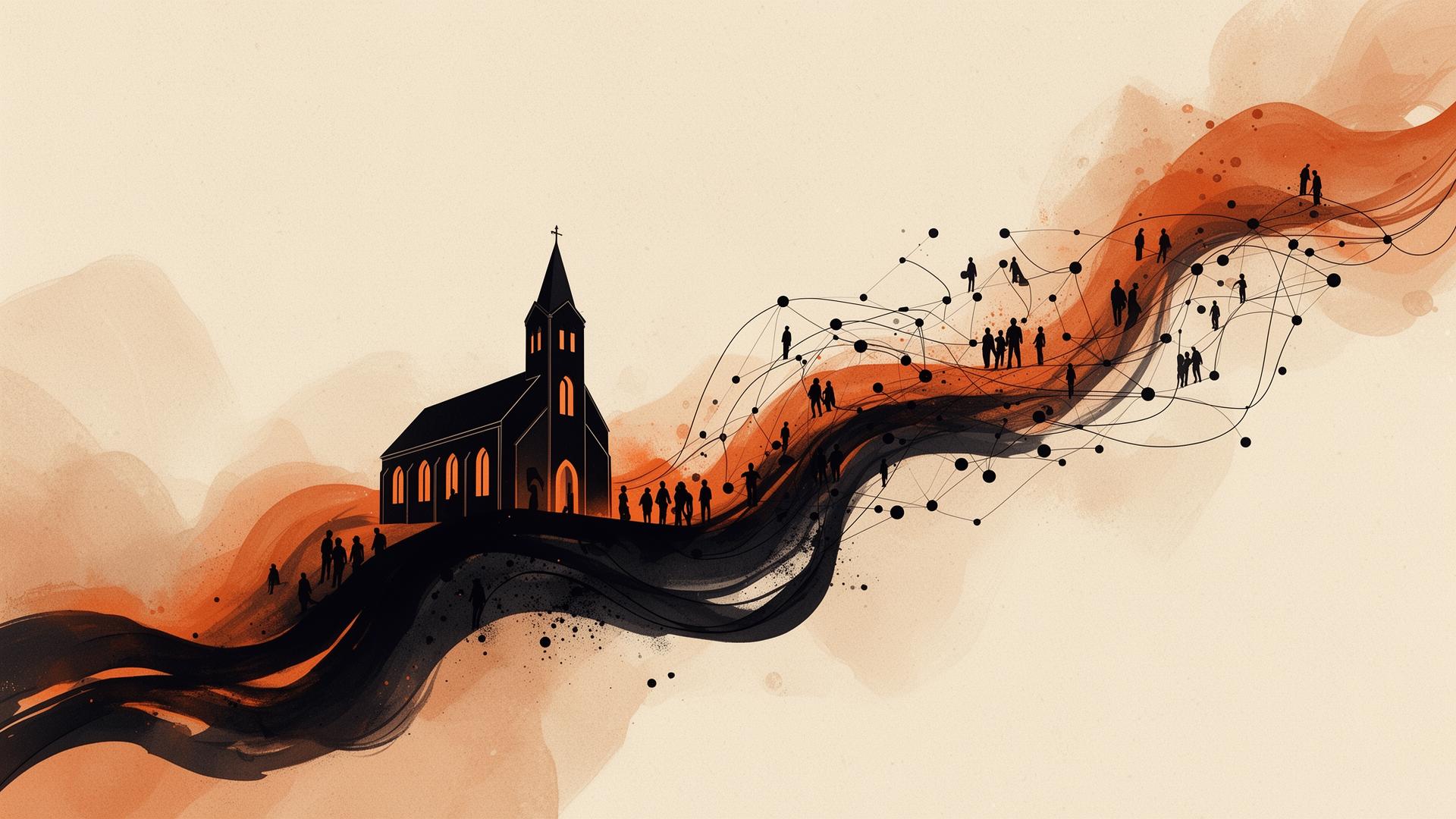
A pastor I love recently told me, almost apologetically, that their invite cards weren't working anymore. The bulletin slot was full. The follow-up email went out on Mondays like clockwork. The new-believer pathway was diagrammed on a wall in the office. And still — people came once, smiled politely, and quietly never came back.
He didn't have a vision problem. He had a systems problem. The architecture he inherited was built for a different century — for a culture where the church was assumed, the invite was social currency, and a phone call on Tuesday felt like care rather than intrusion.
I. The invite is no longer a flyer
For decades, "invite" meant a piece of paper, a parking-lot conversation, or a Sunday-morning announcement that someone would, in theory, repeat. It assumed three things that have all quietly evaporated: trust in institutions, density of neighborhood relationships, and a shared cultural assumption that "church" was a good default.
None of those are true now — not in the way they were. The invite that works in 2026 is not louder, slicker, or more polished. It is smaller, warmer, and embedded. It is a voice note. It is a half-sentence over coffee. It is the dignity of being asked by name, not by algorithm.
The most powerful invite system in the 21st century isn't a campaign. It's a congregation that knows how to introduce one human to another without flinching.
II. The hallway is where most churches lose people
We obsess over the door — the first visit, the welcome team, the lobby coffee. We obsess over the room — membership, baptism, the small group sign-up. But the space between is a hallway most churches haven't mapped at all.
Follow-up, in most places, is still a one-shot email and a hopeful prayer. It treats the new person as a lead in a funnel rather than a soul in a season. People in 2026 do not need to be nurtured into a decision. They need to be walked with through a transition — out of isolation, out of spectatorship, out of the quiet shame of not knowing anyone's name.
A 21st-century follow-up system has fewer touchpoints, but better ones. It assumes the person is busy, skeptical, and tender. It replaces the automated drip with the named friend. It measures not opens, but introductions made.
III. Retention is a word from the wrong industry
We borrowed "retention" from SaaS, and it shows. The metaphor flattens people into users whose continued presence is the goal. But a church isn't trying to minimize churn. It's trying to form saints.
The better word is belonging. People stay where they are known, needed, and given something to carry. Every long-term member of any church can usually point to one person, one role, and one moment they were trusted with something real. That is not a retention strategy. That is the slow, unscalable work of weaving someone into a body.
IV. What this asks of us
Doing church in the 21st century does not mean abandoning systems. It means building systems that serve relationship instead of replacing it. It means measuring different things. It means giving up the comforting illusion that a well-run pipeline can do the work that only a community of practiced, attentive humans can do.
The good news is that the church has done this before. Every renewal in its history has been, at root, a rediscovery of the same small, stubborn truth: people are not converted by mechanisms. They are met. They are walked with. They are given a place to belong before they are given a place to perform.
The door, the hallway, the room. Rebuild all three — but for the century we're actually in.